Author: Simeon Ilev
An independent researcher holding multidisciplinary academic qualifications in international relations, diplomacy, and modern languages. His professional experience includes work in public diplomacy and strategic management, while his research interests focus on diplomatic history, European political thought, and questions of national identity.
Origins and initial purpose
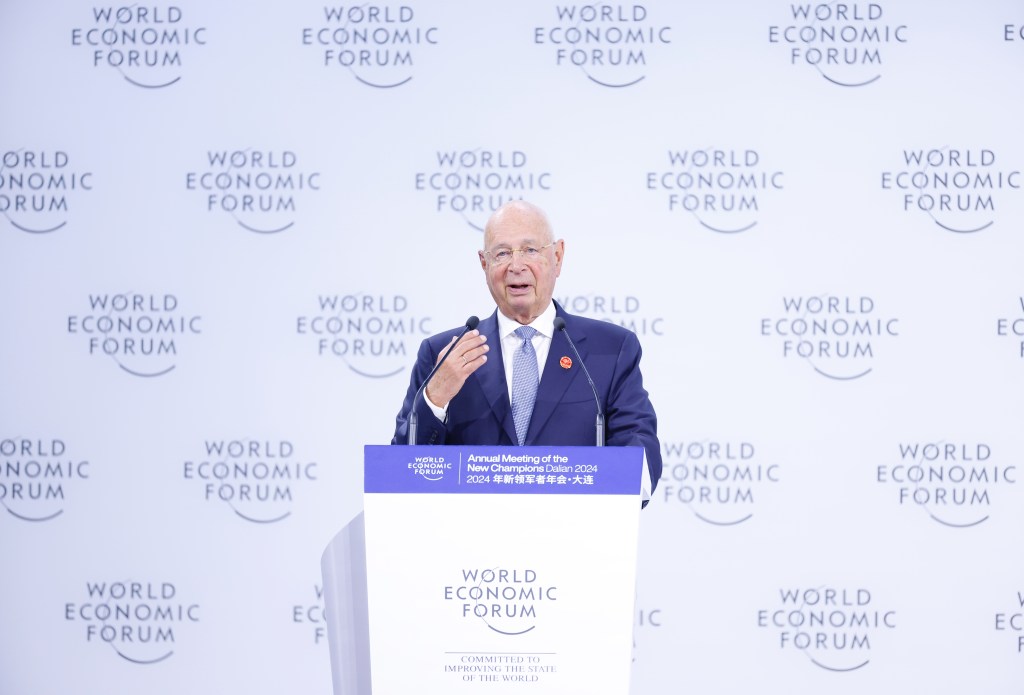
The World Economic Forum, founded in 1971 by Professor Klaus Schwab, has evolved from a modest gathering of the European business elite into one of the world’s most influential institutions.
Originally named European Management Forum, the WEF sought to bridge the gap between European companies and their American competitors by bringing together business leaders and economists to discuss management practices and the global economy. Over time, however, the forum has evolved into an international platform where leaders from all sectors – government, business, academia, and civil society – gather annually in Davos, Switzerland, to discuss pressing global issues.
The idea behind the creation of the WEF stems primarily from Klaus Schwab’s extensive experience in academic and business circles. He observed the rapid postwar economic growth in Europe, particularly in countries such as Germany due to the Marshall Plan from 1948 to 1951, but also noted the lack of cooperation between European companies and American corporate giants. Schwab envisioned a place where European executives could meet with experts from other industries to foster collaboration, improve business practices, and stimulate innovation.
Early expansion
The first meeting, held in 1971, was relatively modest, attracting 400 executives from 31 companies and 17 countries, but it quickly became clear that the forum could serve a broader purpose. Over the next decade, the organization’s influence and scope began to expand significantly. During the 1970s and early 1980s, the global economic landscape was relatively dynamic and marked by volatile changes, including oil crises, inflation, and the aftermath of the collapse of the Bretton Woods system from 1944.
These events clearly demonstrated that economic problems decisively transcended national borders, and thus the WEF began to establish itself as a platform for discussing global issues that went beyond the traditional framework of economic management.
The WEF in the age of globalization
The 1990s marked a turning point in the development of the World Economic Forum. The collapse of the Soviet Union, the end of the Cold War, and the rise of globalization brought about a fundamental shift in the world order and ushered in an entirely new era in which economic, environmental, and political challenges were no longer confined to individual nation-states but were interconnected on a global scale.
Consequently, under Schwab’s leadership, the WEF broadened its focus beyond business leaders to include political leaders, scholars, and representatives of nongovernmental organizations (NGOs).
The organization’s “mission”, so to speak, has evolved to reflect this significantly broader perspective – the annual meetings in Davos have begun to encompass discussions on a wide range of topics, such as environmental sustainability, poverty alleviation, technological innovation, and international trade.
The WEF further solidified its international standing by promoting cooperation among private enterprises, governments, and international institutions.
A platform for the global elite
By the year 2000, the annual meeting of the World Economic Forum in Davos had effectively become a gathering of the global elite. It attracts heads of state, CEOs of multinational corporations, and cultural figures who seek to influence or shape global economic, political, and social trends. Davos has become a sort of synonym for the power dynamics of globalization, as business leaders from developed countries interact with those from emerging economies.
During this period, the WEF’s agenda expanded significantly, focusing on issues such as climate change, the digital economy, international finance, and global health. Public-private partnerships became a key theme, with organizations such as the World Bank, the United Nations, and various nongovernmental organizations participating in the discussions in Davos.
Initiatives focused on social responsibility were also launched, such as the Global Alliance for Vaccines and Immunization (GAVI) and the Global Fund to Fight AIDS, Tuberculosis, and Malaria.
Disruptions and the birth of Stakeholder Capitalism
The 2008 global financial crisis was a turning point for Davos. It clearly highlighted the vulnerability of the global financial system and further provided the forum with an opportunity to engage in critical discussions about the future of capitalism.
As a result, the WEF began to place greater emphasis on economic inequality, corporate governance, and the need for financial system reforms, which in turn was reflected in the growing prominence of discussions on sustainable development, financial regulation, and corporate accountability.
The 2010s were characterized by growing skepticism toward globalization, a widening of economic inequality, and the rise of right-wing populist movements worldwide, particularly in the West. In response to these turbulent events, Davos continued to evolve, adapting to the changing political and social climate and addressing issues such as social justice, cultural inclusion, and climate change with greater clarity.
One of the most notable events during this period was the rise of Greta Thunberg – a young environmental activist who used her platform to challenge world leaders to take drastic measures regarding climate change. In 2019, she delivered a passionate speech in Davos, in which she called on leaders to take environmental issues seriously, thereby increasing the focus on climate change and calling for a more sustainable and equitable form of capitalism.
The term corporate greed became the call of the day. Spread by ever more growing groups of activists, political leaders, academics, economists and other critical members of society, the idea of corporations being held accountable for their actions around the world could no longer be ignored by the elite and therefore the members of the Forum. The widespread public unrest had to be addressed in some way with an appropriate response.
And so, Klaus Schwab responded accordingly: the concept of a new form of capitalism has been born. The concept of Stakeholder Capitalism: the outline for the next phase of industrial development or The Fourth Industrial Revolution, also known as Industry 4.0.
Schwab’s perhaps bold yet necessary theory is precisely described in his book, first published in 2021, Stakeholder Capitalism – A Global Economy that Works for Progress, People and Planet.
It is a visionary concept which suggests that companies must address all kinds of societal issues, be more inclusive and consider the interests of all stakeholders – all participants in the economy.
In his book, Schwab writes:
„Business, like other stakeholders in society, had a role to play in creating and sustaining shared prosperity. The best way to do so, I came to think, was for companies to adopt a stakeholder model, in which they served society in addition to their shareholders.“
The multinational shipping and logistics company A.P. Møller-Maersk for instance is frequently cited by Klaus Schwab as an example of stakeholder capitalism in practice.
Rather than focusing exclusively on short-term profits, the company has been investing in reducing the environmental impact of its operations through more efficient refrigeration systems, lower-fuel vessels and a broader strategy aimed at reducing transport emissions.
As Schwab notes, Maersk has been “experimenting with more efficient ways to keep its food containers refrigerated and using ships that use less fuel and more wind power.”
This clearly illustrates the stakeholder-capitalist idea that long-term business success can be pursued alongside environmental responsibility.
And so, due to the rapid growth of private companies and their immediate influence on our societies in the age of globalization, this new idea has become a highly popular yet controversial topic in business ethics around the world, notably in many parts of the West and interestingly China.
Criticism and controversies
Despite its undeniably growing influence over the years, the World Economic Forum has faced numerous challenges, as a significant number of its critics believe that it primarily represents the interests of a wealthy elite and fails to adequately address issues of power, inequality and broader societal issues, highlighted in its agenda.
Furthermore, the organization is often being accused of promoting a form of greenwashing by focusing on climate change while maintaining close ties with powerful corporations that actually contribute to environmental degradation.
The strong emphasis placed on public-private partnerships raises questions about the effectiveness and fairness of such collaborations.
Critics argue that such partnerships often allow large corporations to influence public policy in ways that benefit them rather than the broader public to influence corporations for greater societal benefits.
The rise of populist movements and skepticism toward globalization have further complicated the WEF’s agenda as well.
The conspiracy theory
With the outbreak of the Covid-19 pandemic, the World Economic Forum, similar to other international organizations, has become a central target for conspiracy theories. And so, largely due to far-right populist movements, Davos has begun to take on an increasingly unfavorable image in the eyes of the broader public.
A number of media outlets, politicians, journalists, and other influential public figures – including the prominent Tucker Carlson, Nigel Farage, Viktor Orbán and Javier Milei – presenting themselves as opponents of globalism, have been rapidly demonizing the organization with the obvious purpose of gaining personal or political advantage.
Strongly opposing the forum’s ideological framework restricting big business, these individuals have been portraying Davos as a gathering of an authoritarian, globalist, or even feudal elite that “secretly rules the world”. An elite involved in the very creation of the Covid-19 pandemic, aiming to establish total control over the masses.
Central to this conspiracy theory is the Great Reset initiative launched by the WEF in 2020.
The Great Reset has a wide-ranging framework; however, it essentially boils down to the creation of a more sustainable, universal economic model in the aftermath of the pandemic.
In essence, the initiative highlights the need for cooperation between big business and political institutions in order to tackle global geopolitical and economic challenges such as growing social inequality, protracted and devastating wars, and global warming.
As Klaus Schwab pointed out in an explanatory article from June 2020:
“The pandemic represents a rare but narrow window of opportunity to reflect, reimagine, and reset our world to create a healthier, more equitable, and more prosperous future.”
Populism, however, by cleverly exploiting the factually unfounded yet widespread criticism of The Great Reset, has managed to misrepresent the initiative’s aims and portray it as a fundamental threat to humanity.
“This is our (their) chance to impose unprecedented social controls on the population in order to bypass democracy and change everything…”, Tucker Carlson said on Fox News in November 2020.
This populist interpretation boils down mainly to the complete abolition of private property, radical digitalization and the universal implementation of the Chinese social credit system, the elimination of individual freedom, persecution and ultimately “enslavement” by a new unelected authoritarian global government.
Ideas of this kind have been circulating since the 1960s under the general heading of the “New World Order”, which itself borrows ideas from conspiracy theories dating back as far as the 18th century.
Continued relevance and future challenges
Since its founding in 1971, the World Economic Forum has undergone significant changes – what began as a small gathering of European leaders has evolved into a major platform for discussing global economic, political, and social issues.
Its focus has broadened to include topics such as sustainability, climate change, and the Fourth Industrial Revolution, reflecting the shifting priorities of the global community.
Although it has been subject to an immeasurable amount of criticism and groundless conspiracy theories, the organization undeniably remains an influential institution that attracts some of the world’s most powerful and influential figures.
Looking ahead, its future will likely be shaped by its ability to adapt to a rapidly changing world. The challenges posed by climate change, inequality, regional conflicts, political instability, populism and technological upheavals have gone nowhere and are in fact more relevant than ever. Overcoming them will require agile and innovative ways for the organization to present itself in a better light to the broader public and to foster urgent and necessary cooperation among governments, business, and civil society.
Whether the forum can maintain its position in a world increasingly shaped by the obviously shrinking relevance of liberalism and the ever more growing one of hostile nationalism will likely be one of the defining questions of its next phase.
References:
- Encyclopedia Britannica – World Economic Forum | History, Davos, & Global Influence | Britannica Money.
- The World Economic Forum.
- Schwab, K., Stakeholder Capitalism – A Global Economy that Works for Progress, People and Planet, 2021.
- Shareholder Capitalism and Stakeholder Capitalism: Commonalities and Differences | Yale School of Management.
- World Economic Forum | Financial Times.


Трябва да влезете, за да коментирате.