Author: Tsveti Monova-Borisova
PhD researcher specialising in Climate Intelligence and Strategic Resilience. A CMDR COE intern with expertise in AI-driven modeling of time-dependent systems, resilience and strategic communications. Holds multidisciplinary academic qualifications in strategic security and defense leadership, international politics and strategic studies, modern languages, and counterterrorism and cyber warfare.
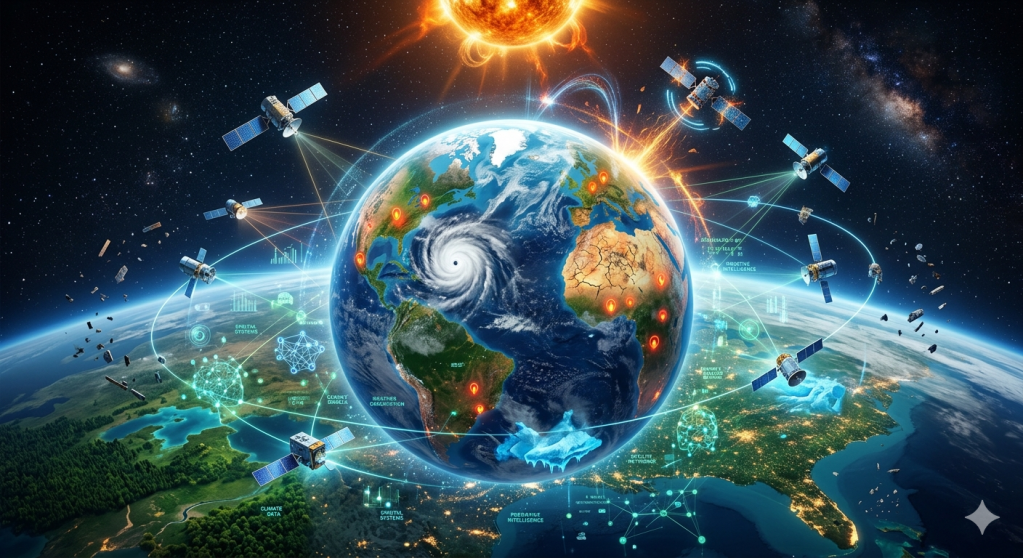
Climate change is widely recognised as one of the greatest challenges of the twenty-first century. Public discussions about climate change usually focus on rising temperatures, melting glaciers, floods, droughts, wildfires, and extreme weather events. These visible environmental changes affect ecosystems, economies, and human societies across the world. However, one of the less discussed but increasingly significant consequences of climate change is taking place far above the Earth – in outer space.
Modern civilization depends heavily on space infrastructure. Satellites orbiting the Earth support communication systems, internet connectivity, navigation, financial transactions, transportation networks, weather forecasting, scientific research, military operations, and emergency response systems. Every day, billions of people use technologies that rely directly or indirectly on satellite services.
Smartphones, GPS applications, banking systems, television broadcasting, aviation navigation, maritime logistics, and cloud-based communication all depend on stable and secure orbital systems (NASA, 2023).
Despite their importance, space systems are becoming increasingly vulnerable. Climate change is creating new environmental conditions that affect both terrestrial and orbital infrastructure. Rising atmospheric temperatures influence the upper atmosphere and orbital dynamics, while increasing solar activity and geomagnetic storms threaten satellite reliability and communication systems.
At the same time, geopolitical tensions, cyberattacks, and the rapid militarisation of space are creating additional risks for global communication networks and critical infrastructure (ESA, 2022).
In this context, climate intelligence has emerged as an essential tool for understanding, monitoring, and responding to environmental and technological threats. Climate intelligence combines satellite observations, artificial intelligence, meteorological science, predictive analytics, and big data technologies to support decision-making and infrastructure protection. It not only improves environmental monitoring but also contributes to economic stability, public safety, national security, and international cooperation.
This article examines the relationship between climate change, climate intelligence, and space infrastructure. It explores how environmental changes affect orbital systems, the role of satellites in climate monitoring, the impact on modern society, and the growing importance of resilient communication systems in an increasingly unstable world.
The Growing Dependence on Space Infrastructure
Over the last several decades, humanity has become deeply dependent on satellite technologies. Satellites support countless activities that are now considered essential for modern life. Communication satellites enable mobile phone networks, television broadcasting, internet access, and global communications.
Navigation satellites provide GPS services used by aircraft, cargo ships, emergency responders, military forces, and ordinary citizens using smartphones. Financial systems also depend heavily on precise timing signals generated by satellites. International banking transactions, stock markets, ATM networks, and digital payment systems require synchronisation that is often maintained through satellite infrastructure (UNOOSA, 2022).
Any disruption to these systems could have serious economic consequences. Transportation systems are similarly dependent on orbital technologies. Aviation relies on satellite navigation and communication for flight coordination and safety. Maritime shipping uses GPS systems for navigation and logistics management. Even autonomous vehicles and modern supply chains increasingly depend on satellite-based positioning systems.
Furthermore, satellites are critical for scientific observation and environmental monitoring. Earth observation satellites continuously collect data about weather patterns, atmospheric composition, ocean temperatures, glacier movements, vegetation changes, and greenhouse gas emissions. Without these systems, scientists would have significantly fewer tools for understanding climate processes and predicting environmental changes (NASA Earth Observatory, 2023).
As global dependence on digital technologies continues to increase, the importance of stable and secure space infrastructure becomes even greater. However, this growing dependence also creates vulnerabilities.
Climate Change and Its Effects on Space Systems
Although space may appear disconnected from environmental changes on Earth, climate change has important effects on orbital systems and satellite operations. One of the most important factors is the interaction between climate change and the Earth’s atmosphere.
Rising greenhouse gas concentrations alter the structure of the atmosphere, including the thermosphere – the upper atmospheric layer where many satellites orbit. Changes in atmospheric density can affect satellite trajectories, orbital stability, and the behaviour of space debris. Scientists have observed that climate change may reduce atmospheric drag in some orbital regions, allowing space debris to remain in orbit for longer periods of time (WMO, 2023).
This creates serious risks because orbital debris can collide with operational satellites. Even very small fragments moving at extremely high speeds can damage communication systems, navigation satellites, and scientific equipment. The increasing amount of space debris has therefore become a major concern for the sustainability of orbital environments.
Another major environmental threat comes from solar activity and geomagnetic storms. Solar storms occur when the Sun releases large amounts of charged particles and electromagnetic radiation into space. These events can interfere with satellite electronics, disrupt GPS signals, damage communication systems, and even affect electrical power grids on Earth (NOAA, 2024). Geomagnetic storms have the potential to interrupt aviation communication, maritime navigation, internet connectivity, and emergency communication systems.
In severe cases, they may cause satellites to temporarily malfunction or permanently fail. As societies become increasingly dependent on real-time communication systems, the importance of monitoring solar activity and predicting space weather continues to grow.
Climate change may also contribute indirectly to the intensity of natural disasters that threaten ground-based infrastructure connected to space systems. Floods, hurricanes, heatwaves, and wildfires can damage communication centers, energy networks, data centers, and satellite ground stations, creating cascading disruptions across multiple sectors.
Climate Intelligence: Definition and Importance
Climate intelligence refers to the integration of environmental monitoring, satellite data, artificial intelligence, predictive analytics, and meteorological science to improve understanding of environmental risks and support decision-making processes (World Meteorological Organization, 2023).
Unlike traditional weather forecasting, climate intelligence focuses not only on short-term predictions but also on long-term environmental trends, infrastructure vulnerability, and strategic planning. It combines data from satellites, sensors, climate models, and digital platforms to provide actionable insights for governments, businesses, researchers, and emergency services.
Artificial intelligence plays an increasingly important role in climate intelligence systems. Machine learning algorithms can process enormous volumes of environmental data much faster than traditional methods. AI systems can identify unusual patterns, detect anomalies, predict extreme weather events, and optimise emergency response strategies. Big data analytics further improves the ability to analyse environmental information from multiple sources simultaneously. Climate intelligence platforms can integrate atmospheric observations, oceanographic data, satellite imagery, and communication network information into unified systems for real-time analysis.
One of the most important applications of climate intelligence is the protection of critical infrastructure. Telecommunications networks, energy systems, transportation systems, internet infrastructure, and emergency response networks all depend on environmental stability and accurate forecasting.
Climate intelligence also supports disaster preparedness and humanitarian response. Early warning systems can provide alerts about storms, floods, wildfires, heatwaves, and other hazards before they cause severe damage. Faster warnings improve evacuation planning, reduce economic losses, and save lives.
Satellites and Environmental Monitoring
Satellites play a central role in monitoring climate change and environmental processes. Modern Earth observation systems continuously collect information about the atmosphere, oceans, land surfaces, ice sheets, forests, and urban environments.
For example, satellites monitor global temperature trends and greenhouse gas concentrations such as carbon dioxide and methane. They help scientists track deforestation, glacier melting, desertification, sea level rise, and ocean acidification. Satellite imagery is also used to detect wildfires, monitor drought conditions, and assess flood damage. Remote sensing technologies enable scientists to observe regions that are difficult to access directly, including polar regions, oceans, deserts, and remote forests.
This global perspective is essential for understanding climate systems and environmental interactions. Satellites are also critical for monitoring air pollution and atmospheric composition. Environmental agencies use satellite data to track pollution sources, monitor industrial emissions, and evaluate environmental policies.
In agriculture, satellite observations support precision farming techniques. Farmers can use climate intelligence systems to optimise irrigation, monitor crop health, predict drought conditions, and improve food production efficiency.
The increasing availability of satellite data has transformed climate science and environmental management. Governments, businesses, researchers, and international organizations now rely heavily on satellite-based climate intelligence for planning and decision-making.
Climate Intelligence and National Security
Climate intelligence has become increasingly important for national security and geopolitical stability. Modern military systems depend heavily on satellites for communication, surveillance, navigation, intelligence gathering, and operational coordination.
Communication disruptions caused by solar storms, cyberattacks, or satellite failures could significantly affect defence systems and emergency response operations. In addition, climate-related disasters may increase political instability, migration pressures, resource competition, and humanitarian crises.
Many governments now recognise climate change as a strategic security challenge. NATO and other international organisations have emphasised the importance of protecting critical infrastructure against environmental and technological threats (NATO STO, 2023).
Cybersecurity has also become a major concern in the context of climate intelligence and space infrastructure. Communication networks and satellite systems are increasingly targeted by cyberattacks. Combined environmental and cyber crises could disrupt transportation, healthcare, finance, and public services simultaneously.
As geopolitical competition in space intensifies, many countries are investing in resilient communication systems, backup satellite networks, and improved monitoring technologies. International cooperation is becoming essential because environmental threats and orbital risks affect all nations regardless of political boundaries.
Impact on Modern Society
Climate intelligence affects everyday life in many ways, often without people realising it. Accurate weather forecasting helps individuals plan travel, work, transportation, and outdoor activities more safely and efficiently. Mobile weather applications use satellite data and climate models to provide real-time updates about storms, fog, snow, heatwaves, and dangerous road conditions.
Public safety systems rely on climate intelligence to issue emergency warnings during floods, hurricanes, wildfires, and severe storms. Faster alerts improve evacuation procedures and disaster preparedness. Healthcare systems also benefit from climate intelligence. Hospitals and public health agencies use climate forecasts to prepare for heatwaves, air pollution events, allergy outbreaks, and climate-related diseases. Rising temperatures and changing environmental conditions can influence the spread of infectious diseases and increase health risks for vulnerable populations.
Urban planning increasingly depends on environmental data and climate analysis. Smart cities use climate intelligence systems for traffic management, air quality monitoring, energy efficiency, and emergency response coordination. The energy sector uses climate intelligence to manage electricity demand and reduce the risk of blackouts during extreme weather conditions. Renewable energy production from solar and wind power also depends heavily on accurate environmental forecasting.
Businesses and financial institutions use climate intelligence for risk assessment, insurance modelling, logistics planning, and supply chain management. Extreme weather events can disrupt global trade, transportation, and production networks, making environmental forecasting increasingly valuable for economic stability.
In everyday life, climate intelligence contributes to greater safety, improved planning, and more efficient responses to environmental and technological threats.
Future Challenges and Opportunities
The future of climate intelligence and space infrastructure will depend on technological innovation, international cooperation, and sustainable policy development. As climate change accelerates, environmental risks are expected to become more complex and interconnected.
One major challenge is the increasing congestion of Earth’s orbital environment. The growing number of satellites and space debris increases the probability of collisions and infrastructure failures. Effective debris management and sustainable space governance will therefore become increasingly important.
Artificial intelligence and automation are expected to play an even larger role in future climate intelligence systems. Advanced AI models may improve predictive accuracy, automate anomaly detection, and support faster crisis response decisions. Future space missions are also likely to include stronger environmental monitoring objectives. Governments and private companies are investing in new generations of Earth observation satellites capable of collecting higher-resolution environmental data.
International cooperation will remain essential. Climate change, space weather, and orbital sustainability are global challenges that require coordinated responses between governments, space agencies, scientific institutions, and private companies. Education and public awareness are equally important. Many people remain unaware of how strongly modern society depends on space infrastructure and climate monitoring systems. Increasing public understanding may help support investment in resilient infrastructure and sustainable environmental policies.
Climate change is no longer only an environmental issue affecting ecosystems and weather patterns on Earth. Its consequences increasingly extend into outer space, where critical communication and navigation systems face growing environmental and technological risks. Modern societies depend heavily on satellites and space infrastructure for communication, transportation, finance, scientific observation, and national security.
At the same time, climate change, solar storms, cyber threats, geopolitical competition, and space debris are creating new vulnerabilities that threaten global stability. Climate intelligence provides essential tools for understanding and responding to these challenges. By combining satellite observations, artificial intelligence, meteorological science, and predictive analytics, climate intelligence improves environmental monitoring, infrastructure protection, and emergency response capabilities.
As humanity becomes more interconnected and technologically dependent, protecting space infrastructure will become increasingly important for economic stability, public safety, environmental sustainability, and international security. The future of climate resilience will depend not only on actions taken on Earth but also on how effectively humanity manages and protects the orbital systems that support modern civilisation.
Bibliography:
European Space Agency. (2022). Space Safety and Sustainability Report. ESA Publications.
European Space Agency Space Debris Office. (2023). Annual Space Environment Report. ESA.
NASA. (2023). Climate Change and Earth Observation Systems. National Aeronautics and Space Administration.
NASA Earth Observatory. (2023). Satellite Monitoring of Climate Systems. NASA.
National Oceanic and Atmospheric Administration. (2024). Space Weather Prediction and Geomagnetic Storm Monitoring. NOAA Space Weather Prediction Center.
NATO Science & Technology Organization. (2023). Climate Security and Critical Infrastructure Protection. NATO STO.
United Nations Office for Outer Space Affairs. (2022). Space Technologies for Climate Resilience. United Nations.
World Meteorological Organization. (2023). State of Climate Services Report. WMO.



Трябва да влезете, за да коментирате.