De Re Militari presents eight of the nine targets that the Indian Army struck in Pakistan-administered Kashmir and Pakistan proper during the initial phase of Operation Sindoor. The graphics contain geolocations based on currently available footage and data.
The Indian military’s Operation Sindoor was a limited counter-terrorism operation in its initial phase, targeting nine suspected terrorist camps in Pakistan and Pakistan-administered Kashmir. The strikes were a direct response to the April 22 Pahalgam terrorist attack in Indian-administered Kashmir in which Resistance Front (TRF) militants, allegedly linked to Pakistan-based Lashkar-e-Taiba (LeT), killed twenty-six civilians, primarily Indian tourists. The Indian defence ministry characterised the operation as „targeted, measured, and non-escalatory,“ emphasising that it focused solely on terrorist infrastructure, such as training camps in Muzaffarabad and Kotli, while avoiding Pakistani military or government installations.
However, Pakistan denies that the strikes targeted terrorists, asserting that they instead hit civilian sites. According to information from the Indian Armed Forces (IAF), precision missiles were employed, and their aircraft did not enter Pakistani airspace. As a result of the operation and the subsequent conflict, 21 civilians and 5 military personnel on the Indian side, as well as 40 civilians and 11 military personnel on the Pakistani side, were killed.
Coordinates: Nathan Ruser/ASPI
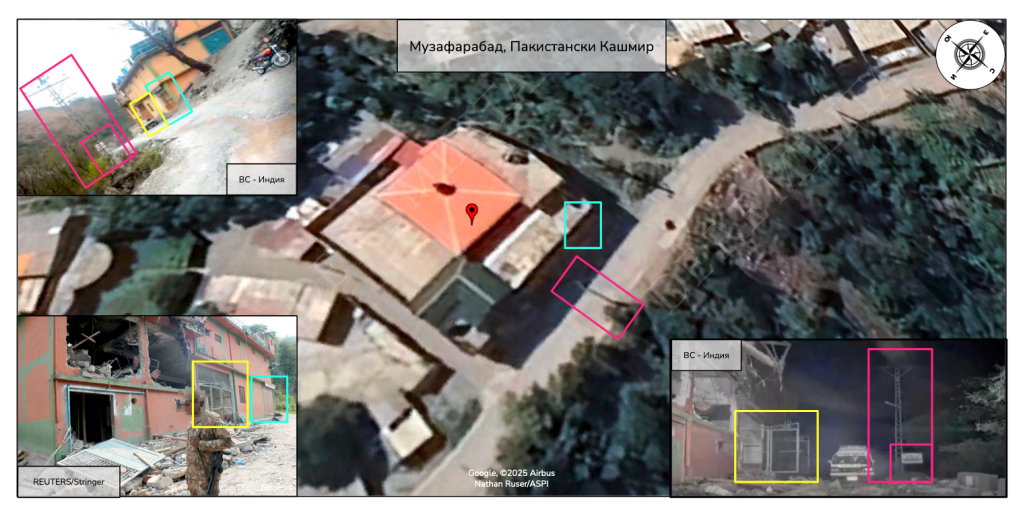
(1) Footage shows the damage inflicted on the Bilal mosque following an IAF strike in Muzaffarabad, the capital of Pakistan-administered Kashmir. The mosque is situated approximately 30 km west of the Line of Control (LoC), the de facto border dividing Indian and Pakistan-administered parts of Kashmir. According to Indian authorities, a training centre for Jaish-e-Mohammed militants, who were instructed in handling weapons and explosives, was located at this site. Both Jaish-e-Mohammed (JeM) and Lashkar-e-Taiba (LeT) are officially designated as terrorist organisations by the United Nations (UN).
Coordinates: 34.3859, 73.4570
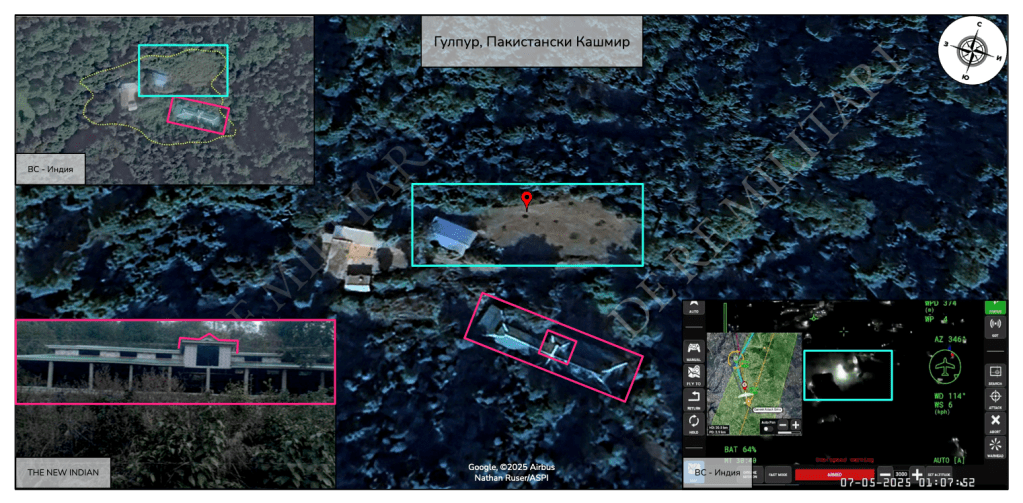
(2) Footage released by the IAF shows a strike on a suspected militant training camp approximately 3.5 km southeast of Gulpur in Pakistan-administered Kashmir. Satellite imagery shows that the suspected camp has expanded in recent years, reportedly doubling in size since 2019.
India says that an attack in June on pilgrims in the Poonch region of Kashmir, which resulted in nine fatalities, was executed by „terrorists“ trained at this base.
Coordinates: 33.4025, 73.8770
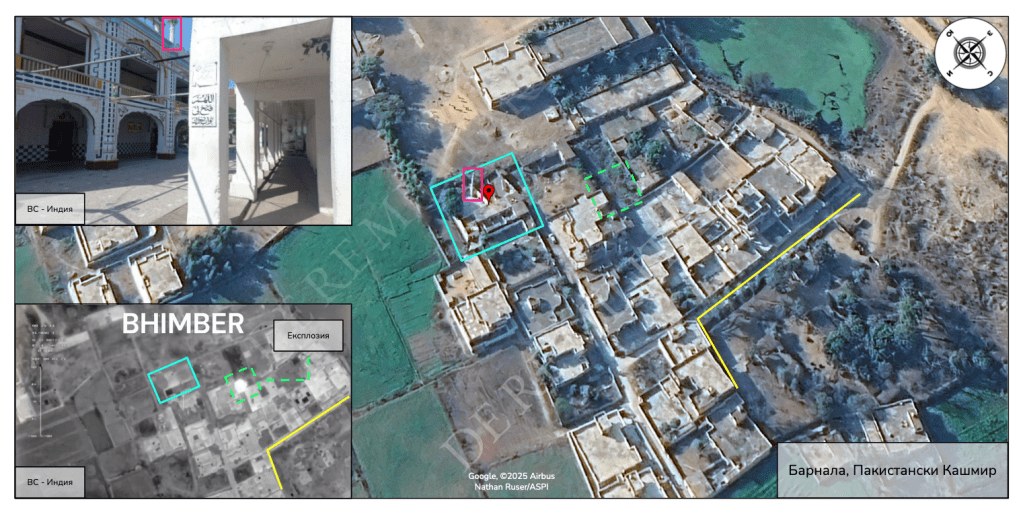
(3) Footage published by the IAF shows an attempted strike on the Ahl-e-Hadis mosque in Barnala, Bhimber district, Pakistan-administered Kashmir. The drone-dropped munition appears to miss the target (indicated in cyan in the graphic) by several tens of metres. The mosque is located 9 km south-west of the LoC and, according to Indian sources, is used for training militants in weapons handling, improvised explosive device manufacturing, and jungle survival techniques.
Coordinates: 32.8678, 74.2564
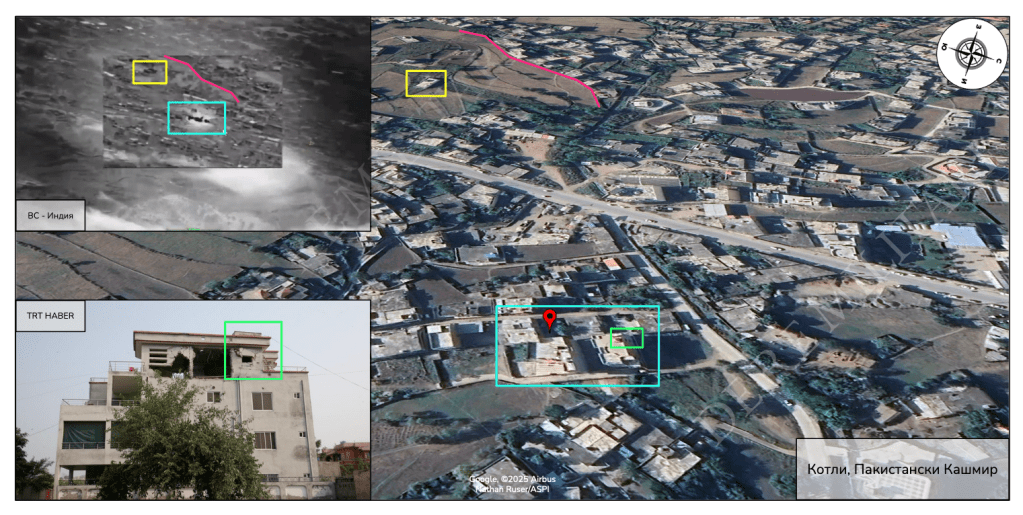
(4) Footage released by the IAF shows at least two air strikes on or near the Abbas Mosque, situated 13 km south-west of the LoC in Kotli, Pakistan-administered Kashmir. This image shows the aftermath of the attack with damage to the interior and façade of the building.
India claims that LeT suicide bombers were trained at this location.
Coordinates: 33.5084, 73.9064
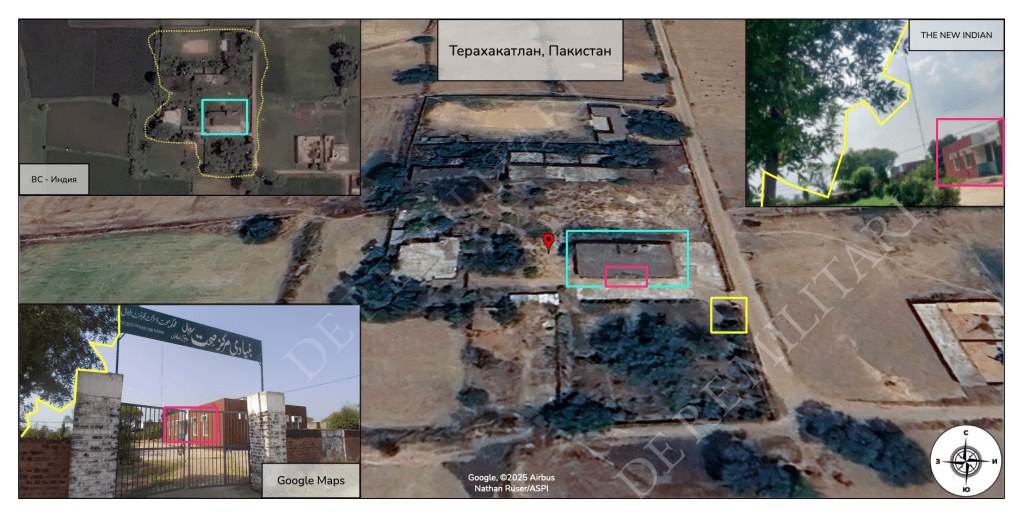
(5) During a press briefing, a representative of the IAF reported that an attack had been carried out against an alleged training camp located approximately 6 km south of the border with Indian-administered Kashmir and about 1 km north of the town of Sarjal, on the outskirts of Terahakatlan. Images published by users on Google Maps in October 2024 show a sign at the entrance to the building indicating that it is a health centre.
India claims that the perpetrators of a March attack, which resulted in the deaths of four police officers in Indian-administered Kashmir, were trained at the alleged camp.
Coordinates: 32.3603, 75.1250
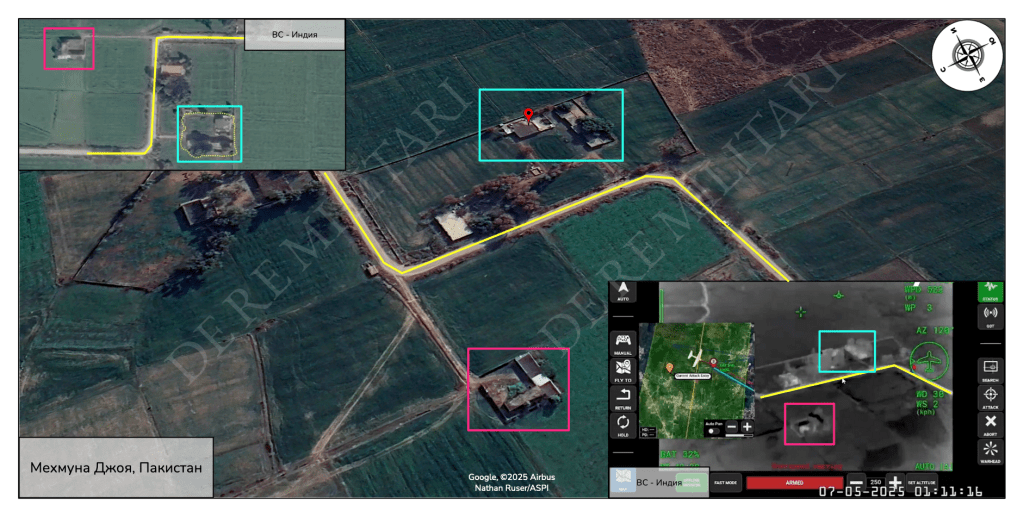
(6) Footage released by the IAF shows a strike on a suspected training camp for militants of the terrorist group Hizbul Mujahideen, situated near a state hospital on the outskirts of Mehmoona Joya in Pakistan, approximately 12 km west of the border with India-administered Kashmir.
India says that attacks planned and executed from this camp include the assault on the Pathankot airbase in 2016, which resulted in seven fatalities.
Coordinates: 32.6169, 74.5056
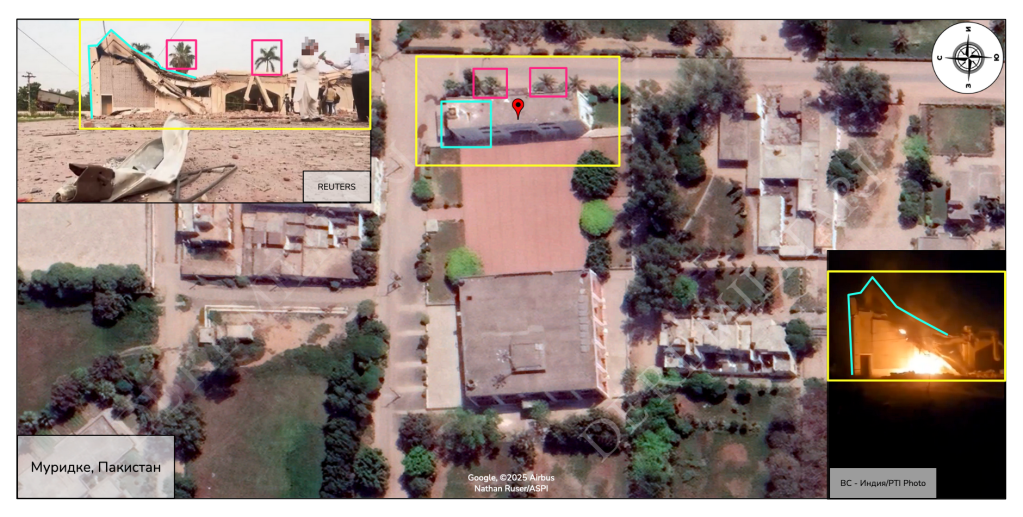
(7) Footage released by the IAF shows at least four air strikes on a section of the Markaz Taiba complex, located approximately 30 km west of the border with India in the town of Muridke, Pakistan. According to a report from the attack site, the severely damaged structure visible in the graphic is an administrative building associated with the local hospital.
India claims that the location is, in fact, a camp and headquarters for Lashkar-e-Taiba (LeT), which is linked to the recent attack in Pahalgam. Ajmal Kasab, the only captured perpetrator of the 2008 Mumbai attacks, was also trained at this centre. The assault in India’s financial capital resulted in the deaths of over 160 individuals.
Coordinates: 29.3735, 71.6182
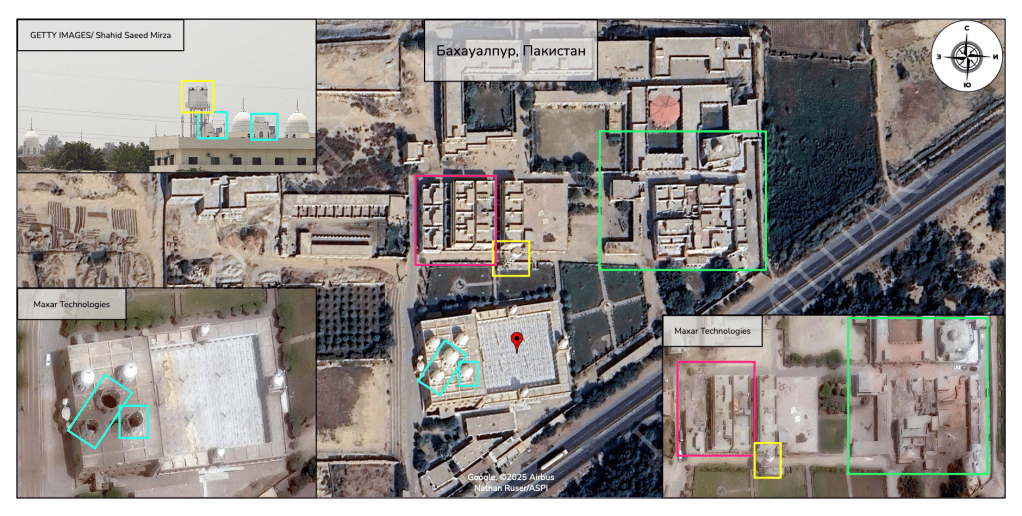
(8) Satellite imagery reveals the aftermath of the IAF’s attack on the Masjid Subhan Allah complex, as well as an adjacent cluster of buildings on the outskirts of Bahawalpur, Pakistan, approximately 100 km northwest of the border with India. At least nine structures were damaged, with around seven nearly completely destroyed.
Indian authorities claim that this site served as a camp and headquarters for Jaish-e-Mohammed (JeM), and was used for recruitment, training, and indoctrination of militants.
Coordinates: 29.3735, 71.6182

 De Re Militari
Трябва да влезете, за да коментирате.